
Your knowledge. Your infrastructure. AI built for your organisation.
We connect your information, adapt open-source models and build the applications and GPU infrastructure that make them useful. From the first data source to day-to-day operation, we design around your processes, people and confidentiality requirements.
- Data and inference under your control
- Models adapted to your work
- From GPU servers to business applications
Every layer has a purpose. And a team to build it.
An example of an internal AI architecture, independent of industry. Explore the components to see what they do, what Tecnosfera implements and how the result is verified.
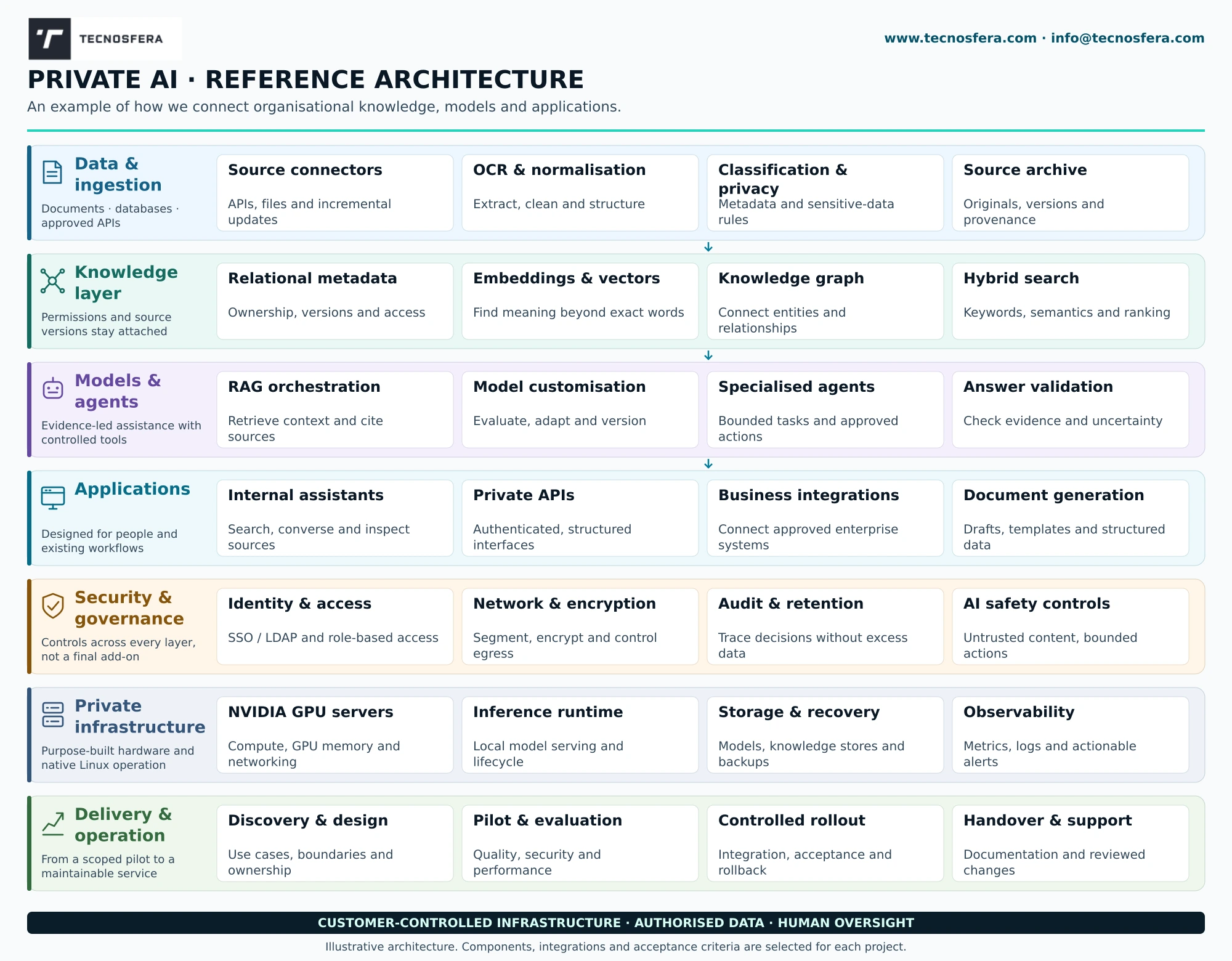
Data & ingestion
Connect and prepare the information that matters.
Documents, databases and business applications hold valuable knowledge in different formats. We build ingestion pipelines around authorised APIs, file transfers and repositories, with scheduled or incremental updates according to the source.
Preparation can include OCR for scanned documents, cleaning, deduplication, classification and extraction of metadata. Sensitive fields can be detected and redacted or pseudonymised according to agreed rules; automated processing still requires validation against representative data.
- Source, version and update history retained with the content
- Data quality checks and a path for handling rejected or incomplete imports
- Retention, access and deletion rules defined with the information owners
Explore each component: purpose, implementation and validation.
Source connectors
- What it does
- Bring authorised data from repositories, databases and business systems into a controlled pipeline.
- What we implement
- Source mapping, least-privilege credentials, scheduled or incremental imports, retry handling and source provenance.
- How we validate
- Reconcile imported records with the source and test duplicates, connection failures and changed permissions.
OCR & normalisation
- What it does
- Make scanned and digital documents usable for search and downstream processing.
- What we implement
- Text extraction, OCR, format conversion, deduplication and document segmentation with page references.
- How we validate
- Check representative scans, tables and malformed files; route unreadable content for review.
Classification & privacy
- What it does
- Organise content and limit the exposure of sensitive information before indexing.
- What we implement
- Document classification, entity extraction and agreed redaction or pseudonymisation rules.
- How we validate
- Measure missed and incorrect detections against labelled examples. Automated redaction is not assumed to be complete.
Source archive
- What it does
- Keep a controlled reference to the material used to create searchable knowledge.
- What we implement
- Versioned object or file storage, checksums, provenance and retention settings; immutable storage where required.
- How we validate
- Retrieve an original from its reference and test access, retention and deletion behaviour, including index removal.
Knowledge layer
Turn scattered content into searchable knowledge.
We combine keyword and semantic search so people can find relevant information beyond an exact phrase. Depending on the use case, the knowledge layer can include vector indexes, relational metadata and a knowledge graph connecting entities and concepts.
Retrieval-augmented generation (RAG) supplies the model with relevant, permitted material when answering a question. We design retrieval around user access, source versions and useful references, so a person can inspect the evidence behind an answer.
- Search across authorised internal sources
- Filters by subject, document type, version and access permissions
- Refresh and removal of indexed content as its source changes
Explore each component: purpose, implementation and validation.
Relational metadata
- What it does
- Track document ownership, lifecycle, classification and permission references separately from generated text.
- What we implement
- Metadata schemas, version tracking and update or deletion propagation across knowledge stores.
- How we validate
- Check that changes to a source or its permissions are reflected in subsequent retrieval.
Embeddings & vectors
- What it does
- Represent document passages for semantic similarity search.
- What we implement
- Embedding-model evaluation, chunking strategy, vector indexing and a controlled re-indexing process.
- How we validate
- Test retrieval relevance across the organisation’s languages and terminology, including unrelated or ambiguous questions.
Knowledge graph
- What it does
- Represent relationships between entities, concepts and documents when the use case benefits from them.
- What we implement
- An agreed entity model, relationship extraction, source-linked edges and graph queries. This layer is optional.
- How we validate
- Review extracted relationships against their sources and test corrections, deletions and conflicting evidence.
Hybrid search
- What it does
- Combine precise matches with semantic retrieval to select useful evidence.
- What we implement
- Keyword indexes, vector search, ranking, metadata filters and permission-aware retrieval.
- How we validate
- Measure relevance and latency with representative queries; test that restricted material is not returned.
Models & agents
Adapt models and agents to the actual task.
We evaluate models against your language, terminology, tasks and available hardware. Prompt design, retrieval and controlled tools come first; targeted fine-tuning is considered when the evaluation demonstrates a need and the available data and model licence permit it.
Specialised agents can assist with extraction, classification, comparison, summarisation and drafting. We define which tools each agent may use, what requires human approval and when it must stop. Source checks and an additional review model can help identify unsupported answers, but do not guarantee correctness.
- Representative test sets and agreed acceptance criteria
- Versioned model, prompt and knowledge configurations
- Uncertainty, missing evidence and escalation made visible
Explore each component: purpose, implementation and validation.
RAG orchestration
- What it does
- Assemble permitted evidence and instructions for each model request.
- What we implement
- Retrieval orchestration, context limits, source references, document-version handling and insufficient-evidence responses.
- How we validate
- Check answer support, reference accuracy and behaviour when evidence is missing, stale or contradictory.
Model customisation
- What it does
- Match the model’s behaviour to the organisation’s tasks, language and hardware.
- What we implement
- Model selection, prompt templates and inference settings; fine-tuning only when authorised data and measured benefit justify it.
- How we validate
- Compare candidate configurations on agreed examples, quality criteria, resource usage and licence constraints.
Specialised agents
- What it does
- Break a workflow into explicit tasks such as extraction, comparison, classification or drafting.
- What we implement
- Task routing, restricted tool access, execution limits, error handling and human approval for consequential actions.
- How we validate
- Test timeouts, unexpected tool results, repeated actions and attempts to exceed the agent’s permissions.
Answer validation
- What it does
- Help identify unsupported statements, invalid formats and inconsistent answers before use.
- What we implement
- Schema checks, source-reference validation and optional independent model review, with escalation to a person.
- How we validate
- Use known failure cases to measure errors that remain. A second model is not a guarantee of truth.
Applications
Bring AI into the tools your teams use.
We build web applications, internal assistants and APIs around the organisation’s workflows. Integration can connect approved business systems and document repositories without requiring users to move their work into a public chatbot.
Possible applications include an internal knowledge assistant, document comparison, structured information extraction, support for operational teams and preparation of reports or first drafts. Each application has its own data permissions, review process and integration scope.
- Conversational interfaces with source references
- Structured outputs and document-generation workflows
- Explicit approval before consequential changes in connected systems
Explore each component: purpose, implementation and validation.
Internal assistants
- What it does
- Give authorised teams a usable interface to organisational knowledge.
- What we implement
- Web interfaces, conversation flows, source inspection, feedback and visible limitations.
- How we validate
- User acceptance, keyboard accessibility and account-switch tests, with checks against cross-user data exposure.
Private APIs
- What it does
- Make selected AI functions available to approved applications.
- What we implement
- Versioned API contracts, authentication, request validation, limits and correlation identifiers.
- How we validate
- Contract, authorisation and load tests; predictable handling of malformed requests and unavailable dependencies.
Business integrations
- What it does
- Fit AI assistance into existing information and operating flows.
- What we implement
- Project-specific adapters, field mapping, scoped read/write access and explicit confirmation for changes.
- How we validate
- Test the integration contract, partial failures, retries and approval boundaries with the system owner.
Document generation
- What it does
- Turn authorised information into useful draft documents and structured outputs.
- What we implement
- Templates, field extraction, rendering, source references and a human review step before final use.
- How we validate
- Check mandatory fields, formatting, source accuracy and handling of missing information.
Security & governance
Build confidentiality and governance into every layer.
Private hosting is a starting point, not a security guarantee. We design identity integration, role-based access, encryption, network segmentation and audit records around the organisation’s policies. Access restrictions must also apply to retrieved content and the tools available to agents.
Documents and model output are treated as untrusted input. Restricted tool permissions, output validation and approval boundaries help contain prompt-injection risks. Logs, backups and support access are included in the data boundary, rather than considered only after deployment.
- Corporate authentication integration, including SSO or LDAP where required
- Controlled outbound connections and secrets kept outside model prompts
- Retention and audit policies agreed with security and privacy owners
Explore each component: purpose, implementation and validation.
Identity & access
- What it does
- Apply the organisation’s identity and authorisation policies to the AI service.
- What we implement
- Identity-provider integration, roles, administrative separation and retrieval/tool permission checks.
- How we validate
- Test denied access, role changes and revocation, including cached results and historical conversations.
Network & encryption
- What it does
- Define where information can travel and how it is protected.
- What we implement
- Network boundaries, TLS, storage encryption, secrets management and approved outbound paths.
- How we validate
- Review certificates, access paths, secret exposure and unexpected outbound communication.
Audit & retention
- What it does
- Support investigation and lifecycle control without indiscriminately recording sensitive content.
- What we implement
- Audit events, model/configuration version references, log minimisation, retention rules and deletion procedures.
- How we validate
- Trace representative requests and test access, retention and deletion behaviour across logs and stores.
AI safety controls
- What it does
- Limit the impact of malicious document instructions and unsafe model output.
- What we implement
- Separation of instructions from source content, restricted tools, output validation and human approval gates.
- How we validate
- Adversarial tests for prompt injection, data disclosure and unauthorised tool use; document residual risks.
Private infrastructure
Purpose-built NVIDIA GPU servers. Locally operated AI.
We design, assemble and configure servers with NVIDIA GPUs, selecting compute, GPU memory, RAM, storage and networking for the chosen models and workload. The hardware and inference runtime are sized together, rather than treating the server as an afterthought.
Models, knowledge stores, inference and operational logs can run entirely on customer-controlled local infrastructure, without a public AI API at runtime. We support native Linux deployments without making Kubernetes a prerequisite. Monitoring, backup and restoration procedures form part of the agreed operating design.
- Capacity planning and tests for the expected concurrent workload
- Monitoring of latency, errors, queues, GPU usage and storage
- Controlled model updates, rollback procedures and recovery tests
Explore each component: purpose, implementation and validation.
NVIDIA GPU servers
- What it does
- Provide the local compute capacity required by the selected models and workload.
- What we implement
- Server design, assembly and configuration, including GPU memory, RAM, CPU, storage, network and thermal requirements.
- How we validate
- Test representative model workloads, concurrency, memory headroom and hardware stability.
Inference runtime
- What it does
- Load and serve approved models with predictable resource controls.
- What we implement
- Native Linux services, model serving, request queues, resource limits and versioned configuration. Kubernetes is not required.
- How we validate
- Measure response times and test overload, restarts, controlled upgrades and rollback.
Storage & recovery
- What it does
- Protect operational data and make recovery an exercised process.
- What we implement
- Storage sizing, backup policies, protected copies and restoration procedures for agreed system components.
- How we validate
- Restore representative backups and verify consistency. Recovery targets are agreed per project, not assumed.
Observability
- What it does
- Make performance, failures and resource pressure visible to operations.
- What we implement
- Dashboards for availability, latency, errors, queues, GPU, CPU, memory, disk and network; scoped logs and alert routing.
- How we validate
- Exercise failure scenarios, check alert delivery and confirm that logs do not expose unnecessary sensitive data.
Delivery & operation
A practical path from discovery to operation.
We start with a defined problem, authorised information and measurable acceptance criteria. A focused pilot establishes whether the model, retrieval and hardware are suitable before the application is integrated into wider workflows.
The agreed delivery can cover data connectors, the knowledge layer, model configuration, application interfaces, infrastructure and operating documentation. Components and service scope are selected per project; this is not a fixed stack or a claim that every deployment needs every layer.
- Discover: map use cases, data, users and confidentiality requirements
- Validate: test answer quality, access controls and performance with authorised examples
- Integrate: connect the application and run a controlled rollout
- Operate: monitor, support and review changes against the agreed baseline
Explore each component: purpose, implementation and validation.
Discovery & design
- What it does
- Agree what the system should do and the information it may use.
- What we implement
- Use-case mapping, data inventory, architecture, responsibilities and measurable acceptance criteria.
- How we validate
- Review assumptions and scope with the business, information, security and operational owners.
Pilot & evaluation
- What it does
- Establish evidence before expanding the deployment.
- What we implement
- A focused pilot, authorised evaluation examples and comparative tests of models, retrieval and hardware.
- How we validate
- Review results against the agreed baseline and document limitations and unresolved risks.
Controlled rollout
- What it does
- Introduce the solution into approved workflows in manageable increments.
- What we implement
- Environment configuration, integration tests, staged access, operating checks and a rollback plan.
- How we validate
- Confirm acceptance with the designated users and rehearse failure recovery before widening access.
Handover & support
- What it does
- Keep the solution understandable and maintainable after initial delivery.
- What we implement
- Operating documentation, team handover, monitoring and an agreed support and update scope.
- How we validate
- Re-run relevant evaluation and recovery checks when models, data sources or infrastructure change.
The essentials, without ambiguity.
Can the solution run entirely on our own infrastructure?
Yes. Models, knowledge stores, inference and logs can be deployed locally without calling a public AI API at runtime. Downloads, updates, telemetry, backups and support access must also be reviewed to establish the required network boundary.
Do our documents have to train the model?
No. RAG retrieves relevant information for a request without changing the model’s weights. Fine-tuning is a separate decision, with authorised data, a defined purpose and its own evaluation.
Does a private model eliminate incorrect answers?
No. Local hosting does not remove model errors. Retrieval, references, testing, refusal behaviour and human review help manage the risk; an answer with a citation still needs to be checked against its source.
Is this service limited to one industry?
No. We adapt the architecture to an organisation’s information and workflows. The use case, source access and acceptance criteria determine the implementation, rather than a sector-specific application.
Do we need every component or a Kubernetes cluster?
No. We select the smallest architecture that meets the agreed requirements. Native Linux operation is supported, and a knowledge graph, additional agents or fine-tuning are included only when justified.
How are models and open-source components selected?
We consider task quality, language, hardware requirements, maintainability and licence conditions. Model weights being available does not by itself mean unrestricted use; the licence is checked for the intended deployment.
Start with the work you want AI to improve.
Tell us about the use case, information sources and confidentiality requirements. We can define the application, model and infrastructure together. Do not include confidential documents in the first email.